Showing posts with label weather. Show all posts

Sunday, May 22, 2011

Kotzebue in the Spring

Looking out over the lagoon to the tundra from Kotzebue.
In the distance, an occasional dog barks.  Down the dirt road from our apartment Iditorod winner John Baker kennels his dogs. There are also the sounds of seagulls but no screeches from the huge ravens feeding off the remnants of food found in open dumpsters throughout this native village located above the Arctic Circle. Mostly it's just quiet.

Early afternoon as people begin to emerge in Kotzebue.
Since the school year ended, the sleep cycle of many Eskimos living in the Village of Kotzebue has been reversed. Sleep during the day and up in the late afternoon makes for empty streets and quiet in the mornings. Traditionally Eskimos slept during the heat of day and performed subsistence work at night.

The tradition of sleeping during the day continues to be handed down to the young people of this generation. Kotzebue streets are filled with children playing out on bikes, walking the streets, and stomping through puddles until the the late-night hours. Some children at the club brag of the all-nighters they have already experienced this year. Of course not all have the luxury of this lifestyle. Work in this community continues on its normal schedule in a similar way to any community in the Lower 48.

The signs of an early break up can be seen up river. Extensive flooding is occurring in Buckland and the tiny village of Kobuk. Emergency crews from the Northwest Arctic Borough were flown to these remote villages to evacuate residents from their homes to the village schools yesterday.

Nowhere for the water to go during the melt.
The effects of the melt are continuing to be felt here in Kotzebue. This frozen strip of land stands as a barrier to the waters accumulating from melting snow and ice. City public works crews are busy pumping out the excess water collecting in large puddles around the village. Cars and four wheelers ride over the crisscross of swollen hoses that are redirecting the muddy water from the low-lying areas out towards the Sound, lagoon, and Swan Lake.

Mosquitoes are beginning their short lifespan here in the Arctic. A five-year old in the next booth chanted "mosquito, mosquito" at Bayside Restaurant yesterday where I was eating a late lunch. From our vantage, we could see the calming stretch of ice over the Kotzebue Sound.

Construction season has begun along Front Street.
Construction season has resumed along Shore Avenue with AIC working to complete the road project begun last summer. On a walk yesterday, I saw orange cones lining portions of the roadway while a bulldozer moved gravel and dirt that had been barged in last summer from Nome. The huge bump outs lining this street that fronts the Kotzebue Sound will be landscaped with native plants and flowers as well as placement of interpretative signage, benches and picnic tables. The huge sheet pilings that were driven into the permafrost last season are continuing to hold the remaining soil from being washed away. Erosion is a serious problem throughout the Northwest Arctic Borough due to continued shorter and more mild winters.

Construction of the new hotel continues.
The new high-rise hotel that SKW Eskimos, Inc. is building will be completed this summer. This structure dwarfs the old hotel that is located within feet of the new building along Shore Avenue. A proud accomplishment by NANA Development Corporation, the new Nullagvik Hotel is due to open this fall with 78 guest rooms, a year-round restaurant and other amenities.

One of many flights out to the villages.
The loud sound of a prop plane punctures through the silence of this early morning hour. On clear days like today air travel is permissible out to the villages from this hub city. Their loud, engine sounds stand as a reminder of the remoteness of this region where most communities are only accessible by air this time of year.

These planes serve as a reminder of the valuable link between this city to its neighboring inhabitants spread throughout this vast region. The great ice road has already closed for the season. The air has returned to its quiet stasis, and breakfast is calling my name.

Sunday, May 1, 2011

Effects of the Melt on Kotzebue

Large puddles accumulate during the melt.
Something I didn't expect to happen so soon did. The melt has begun. People have said this season is the ugliest of the four up here in the Far North. I believe them.

Spring is the season of the melt. The snow melts from the land, and the ice recedes from the shore. For the first time this season, we saw seagulls on the Kotzebue Sound. While some friends and I were having dinner, my friend looked out the window of the Bayside Restaurant and observed that there were seagulls on the Sound.

"There's open water out there," she exclaimed. We stared out the window in amazement partly because the timing is not right. It is too early for the melt. Normally the ice begins to melt later in May. Temperatures normally stay well below freezing at this time.

The warmer weather has had other effects on life in Kotzebue and other places around the Northwest Arctic Borough. Fog. As the air above the ground begins to warm and the snow melts, fog is created. The gray days are upon us, and travel has been made more difficult.

Aerial view of the road leading into Noorvik.
Last Tuesday Rick and I traveled out to Noorvik to visit one of the clubs. The morning flights had been canceled the day before due to fog. Visibility has to be at least a mile for Alaska Airlines to fly their jets and less for the smaller planes.

At the counter of Era Alaska, I paid a little extra for a refundable ticket. As we waited in the small terminal, we talked with a friend who was going out to the tiny village of Kobuk. The fog had begun to clear but calls continued to come in from nervous travelers who were checking flight status for the day's flights. The fog continued to dissipate. Until the woman behind the ticket counter saw the pilots begin to walk up to the terminal, the answer to those inquiring travelers was always that we were in standby. I breathed a sigh when the status changed. Our flight took off soon thereafter.

Another amazement of spring is the increased daylight. As we stared out the restaurant's window on Front Street, we noticed young children playing out. Looking at my watch, I noticed the clock indicated 8:10 pm. Since the sun will not set until 11:35 pm tonight, our bodies are confused about what is our bedtime. Soon our youth will be out of school. Many of them will play out late into the night; some not returning home to their beds before early morning. This habit of daytime sleep during summer is deeply ingrained as their ancestors flipped the sleep cycles to take advantage of the cooler time of day for hunting and fishing.

To force our bodies to stay on their sleep cycle, we have to introduce artificial night to them. Shutting the blinds and closing the curtains tells our bodies that it is time to wind down for the day. I peer through the slats in the blinds in disbelief from time to time.

The miracle of living at the top of the world has been the hours of light in the sky throughout the year from no sunrises to no sunsets. Throughout the year I watch and wait for the sun to arrive as it moves around the Kotzebue horizon. From what direction will it arrive tomorrow, I wonder. Currently the sun is setting in the southwest and rising in the northeast.

Dirty water from melting ice collects in huge puddles on the gravel streets in this Eskimo village. On the few paved streets, the water finds other places to collect. The parking lot at Teacher Housing had a big lake towards Building A. The frozen ground stands as a barrier to the overwhelming bounty of water produced during the melt. Some of the water is drained with pumps by the Department of Public Works. As the sustained temperatures heat up the earth, the water soaks into the marshy soil. Gravel barged in from Nome is used to patch the potholes and ruts forming on the thoroughfares. Brown snow mixed with garbage and dirt is transported on loaders to areas near Swan Lake, the Lagoon, and the Kotzebue Sound.

Gone is the glittery, white blanket of winter. And with it, are the subzero temperatures when layers of clothing assured survival. The humidity in the air increases during the melt. We celebrate the warmer temperatures by wearing lightweight fleece jackets and short sleeve shirts. Sometimes even shorts will be worn. Rain boots replace bunny boots to keep our feet dry and cool. Even with all its ugliness, we celebrate the melt and the coming of spring. We say good riddance to the cold temperatures. For the transplants, we breathe a sigh of relief that we survived another winter above the Arctic Circle.

Sunday, April 24, 2011

Easter in Kotzebue and Kivalina

Kotzebue sunset, Arctic Alaska
Easter is a time of renewal in Kotzebue.
Easter is a very important holiday to Eskimo people living in Qikiktagruk, or Kotzebue as it is most widely known. A ray of hope shines brightly for these deeply religious people. Easter is a time of renewal and celebration. Their hearts are filled with gratitude for another year of survival and for a resurrection that continues to promise them relief and salvation. The worst of the Arctic cold has subsided, the melt has begun, and the temperatures warm their bodies. Other signs of Easter can be found here.

While Rick and I were out yesterday, we saw many cars parked at the Baptist Church along Front Street. Friday night was filled with praise and worship at the local churches. There are many churches located in this hub city above the Arctic Circle. Represented are the Roman Catholic Church, Episcopal, Quaker (The Friends Church), several Baptist churches, the Church of the Latter Day Saints, and the Seventh Day Adventist Church.

Perhaps there are so many churches in this village of 3300 because the Inupiat people throughout history have been deeply spiritual. Their culture was at one time guided by their 17 Inupiaq values. And at the heart of those values is a respect for elders, for others, and a respect for nature. When the missionaries came to this foreign land in the early 1900s, these people were converted to Christianity. Their native practices were shunned and their children forced to attend schools far away from their parents. As time went on, the Inupiaq values were no longer taught to their children. But those values remained in the hearts of the elders.

Today there are many attempts to bring back the old ways, including the Inupiaq values. At the club, we are teaching the kids those values. The youth are recognizing their use and importance in their everyday life. At the recent Arctic Circle Spring Festival, there were traditional activities including Eskimo football, an ice fishing derby, and harpoon contest, and snowshoeing race. At the awards banquet where the winners of the Kobuk 440 were announced, Eskimo dancing and drumming entertained attendees. Families recovering from addiction may a visit to the old Spud Farm as part of their rehabilitation. These families learn the Inupiaq values and engage in traditional subsistence activities.

Kivalina in rural Arctic Alaska
Kivalina is located on an 8-mile barrier reef. near Chukchi Sea.
Residents of the Eskimo village of Kivalina celebrate Holy Week with food, prayer, singing and fellowship. Each day Eskimos spend hours collectively in preparation for their most important holiday: Easter. Services on Good Friday and Easter may last up to four hours each or more. As part of the preparations for this most holy holiday, cold storage units are cleaned out in preparation for whaling season. Eskimos in this village 120 miles north of the Arctic Circle continue to hunt beluga whales for their survival. Teams of hunters will begin to follow the ice leads in search of migrating whales. (For a personal accounting of whaling in the Barrow area, click on the link.)

The Alaska Commercial store in Kotzebue displayed the western symbols of Easter. A large display at its entrance contained Easter baskets, candy and lilies beginning early this month. Easter candy was a favorite purchase among youth and adults throughout Lent. Kids showed up at the club on Friday buzzed out on sugar from candy eaten at school that day.

The peace and relief is in the air in this Eskimo Village. May the blessings be realized in Kotzebue, Kivalina and the other villages throughout the Northwest Arctic Borough on this day. May we all enjoy the plentiful light in the sky and the warmer temperatures as the season of Melt continues.

Thursday, April 14, 2011

Spring in Kotzebue

Sunrise over the Tundra in Kotzebue.
Sometime between the end of March and the beginning of April, spring arrives in the Northwest Arctic. The temperatures hover in the single digits and the daylight becomes everyone's best friend again. We went from near total darkness just before Christmas to more than 15 hours of daylight in the span of three months.

A visitor might wonder what's different about this Eskimo village now that the sun has returned. Many things remain the same. The temperatures continue to fall below zero degrees at night. The snow melts and refreezes, brought on by climate change and a hint of warmer weather. The snow glitters like diamonds and falls so gently on the frozen earth. However, many things are different. The light welcomes us in the morning and stays with us long after many have retired for the night.

Our bodies are adjusting to the additional light. We show our hardiness to the cold by casting aside our snow pants. Some of the youth wear capri pants or thin fleece jackets when their parents let them. Sunglasses or goggles are worn to protect our eyes from snow blindness. We stay up later and our bodies require less sleep. The youth play out at night. The drone of snow machines can be heard from our living room until the late hours.

Sunset over the tundra outside of Kotzebue.
What is most interesting is the location of the sun. The sun skips around the sky throughout the year rising in an area for a short period time before occupying another space on the horizon. The sunsets change their escape from the sky along the horizon in many places. This fireball clings to the horizon when it begins its ascent into the small sky. Its long stretch above the horizon distorts the round shape of the orange sphere.

The sun throws color into the sky announcing its presence around 7 am each morning. When Rick and I head off to work at 8, the sun hangs in the sky as though it were nearly noon. Long after our return from work, the sun washes the small sky with fushia, orange and yellow. Between those times, the sun consumes the sky and the earth of this Eskimo village. The flatness of the earth on this gravel spit makes the sky appear as though it were hugging the horizon on all sides, especially during the winter.

Cemetery Hill outside of Kotzebue.
There is much beauty in this city located above the Arctic Circle. The sun brings color to the sky, and the snow glitters in its light. The low lying brush of the tundra is covered by deep snow, only occasionally showing its dried branches laced with white. The frozen waterways make travel to the other villages easy with snow machines or dog sleds. This shroud of white brings a simplicity to the landscape.

With all this daylight, some of us are sprouting flower seeds and preparing our indoor gardens for another growing season. Recently I attended a seed planting workshop at the Senior Center. We are growing flowers for the elders in a large window at the club. During the summer months, raised beds will create a garden experience for the elders living at this home for the elders in the community. Others will grow short-season crops in outdoor beds at their homes. Some will even make their own compost.

We are all happy that spring is here. The sun is back. The orange orb shines with a brightness that is native to this place. In another few months, the ice will recede from the land and the Kotzebue Sound. Another winter has passed.

Monday, March 28, 2011

Looking Back on the First Year in Kotzebue

Kotzebue, Alaska fireworks
Fireworks during New Year's Eve celebrations.
As our first year in Kotzebue comes to a close, I look back at this time of intense learning and change. This past year has brought much change to our lives. The post below chronicles prior to our arrival and in the nearly one year completion of work here.

When Rick interviewed with the City of Kotzebue last March. After four months of being laid off, it was time for a new adventure. The opportunities for growth and economic development in the Northwest Arctic Region are so great. We were excited when Rick was offered the position. Rick began work at the beginning of May 2010.

Rick and I traveled to Kotzebue the last week of April to get him settled. April is a busy time of year in this community of 3,300 with more than 70 percent Eskimos. We rented an apartment sight unseen due to the shortage of available units in April when construction and fishing season was about to begin.

Stepping off the plane, we were met with cold unlike any I had experienced. Over the course of several months, my body would acclimate to the harsh environment in this hub city. I was amazed at the beauty of this snow covered place in the tundra. Ice covered the Kotzebue Sound, Swan Lake and the lagoon. We were told that spring had arrived and we had begun our stay at a bad time: during melt or break up. Each day the snow receded uncovering piles of discarded trash. Too cold to make it out to the curb during arctic storms, trash was stockpiled near the kunichuks of each dwelling. A kunichuk is a space with four walls and doors at each end: one entering the dwelling and the other to outside.

Kotzebue, Alaska, tundra
View of Kotzebue from the tundra.
Our plan was to visit each other on long weekends and use Skype during the intervening times. After a few such meetings, I decided to make the move and arrived in July after the snow had melted. Summer was in full swing with temperatures in the 50s. Kotzebue is nearly surrounded by water providing a rich habitat for fish and other animals. Berry picking and hikes into the tundra were normal activities. What amazed me the most is that there are no trees. The arctic winds and permafrost are not suitable for such vegetation. 

Beginning a job just days after my arrival, I was confronted with experience where nothing worked. That's how it felt while in reality, most things worked but intermittently failed. Calling down to the Lower 48 sometimes failed. Even calling locally worked intermittently. Levels of food at the grocery stores fluctuated depending on available transport. Alaska Airlines flights, promised at three a day, sometimes were canceled due to inclement weather. My company vehicle would intermittently malfunction. Due to the dry climate, static electricity would spark off my fingers. This phenomenon was not intermittent. It was constant.

Fall arrived in August with the temperatures dipping once again. While local people often say there are only two seasons in the tundra, the subtly of the change of season caught my attention. Nights cooled while leaves on native plants began to turn bright shades of maroon and yellow. Cranberries ripened on their low-lying branches as other berries reached the end of their bearing cycle. People kept telling us there  would be another warm spell before fall. I waited but could feel the slow retreat of the effects of summer.

Freeze up on Kotzebue, Alaska, lagoon
The lagoon during "freeze up."
The first snow that stuck came in October. Taking pictures around Kotzebue, I took in the beauty and peace of this occurrence. Ice had formed on the edges of the lagoon outside our apartment and puddles gained a thin layer of ice. With trepidation, I embraced the cold. (For more information, see blog post "Freeze Up is on its Way")

We drove our car up the Alaska Highway during this time. Nightly posts on this blog helped us stay in touch with family interested in our progress along the five day journey through western Canada and southern Alaska to Anchorage. Since Kotzebue is not on the Alaska road system, the car would remain in Anchorage. Barging the car to Kotzebue during the summer would have cost thousands of dollars. (Nightly posts of this trip can be read, beginning with Preparing for the Flight to the Lower 48.)
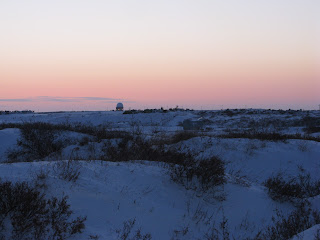
Winter sunrise over the tundra in Kotzebue, Alaska
Sunrise on the tundra at 11:30am.
Rick and I took trips to see family and friends during the early to mid winter as each day the light in the sky weakened its hold. Viewing the weather statistics on Accuweather.com became a daily ritual. Sometime during the first three weeks in December as the light diminished by more than seven minutes per day, a friend helped me appreciate the darkness. Hours before the sun lazily appeared on the horizon, a deep blue color shrouds the landscape. This twilight became the mainstay of my mornings at the club as I gazed out the large window at the north end of the Kotzebue Sound. Stunning.

Native Alaskan parka {parkie} in Kotzebue, Alaska
The Winter Solstice was elevated to a major holiday for some of us. Once we passed this threshold, the daylight began to return in rapid succession. The sun left its weak stance on the horizon and rose high in the sky. Huge plows raked the roads clear of record breaking levels of snow. Huge drifts and piles became play toys for kids snuggled in their winter parkas, snow pants, hats and gloves. Additionally I began to don a face sock to prevent possible skin damage. Temperatures often dropped to -20 to -30 degrees and my new parkie protected me from the wind chill that sunk the occasional temperatures to -40 or so. (For more details, read posts Parkie for Christmas, and Losing Daylight in the Far North.)

The roads were charted across the Sound allowing the Arctic Cats and other snow machines to race across the ice to distant villages. The joys of winter were celebrated in full force with snow machines, cross country skiing and snowshoeing, and sledding down Cemetery Hill and other places. (For more details, read blog posts: Life in Below Zero Temperatures, A Sunday During the Holiday Season in Kotzebue, Snow Flurries in Kotzebue, and Blizzard in Kotzebue.)

I embraced the cold after a Christmas trip to see family. I began to understand the need to get out every two to three months during this time of year. Many local organizations and municipalities plan trips and retreats in Palm Springs, California, and Las Vegas, Nevada during this time. Seeking a break from the long, cold days, upcoming trips to Hawaii and Mexico dominated the conversations in the line at the post office. Many of us waited in long lines to pick up Internet or mail orders as well as Christmas gifts. Shelves at the local stores had gaping holes where items had been sold out and not replenished. Canceled flights and planes filled with passengers prevented goods from being restocked.

February arrived with blizzards that created white-out conditions. The club was closed for a few days as the danger of local travel became our reality. Being home bound helped me appreciate having a safe, warm place to live. Schools were closed early or snow days were called. We listened to KOTZ radio each morning as Bob announced the snow conditions and school schedule for the day. The winds howled at night as their speeds reached over 40 miles per hour. The isolation became intolerable. We traveled to Anchorage for a long weekend to escape. (For more details, see posts Waiting Out Another Storm in Kotzebue and Weekend Away from Kotzebue.)

arctic winter in Kotzebue, Alaska
Patches of over water seen from the tundra.
Near the end of the month, temperatures rose to an unseasonable 30 degrees. While some of us enjoyed the springlike conditions, the dangers of early snow melt were felt by all. Flooding along Shore Avenue required evacuation of residents along that street. High tides on the Sound that were normally masked by layers of ice thrust pieces of ice onto the road. Ice travel became dangerous in spots where over water had formed on the Sound, lagoon and Swan Lake. Examples of the climate change were witnessed throughout the Northwest Arctic Borough as far east as Buckland and south in Selawik. (For more details, read post Unseasonably Warm Temperatures Cause Flooding in Kotzebue.)
Kotzebue lagoon sunrise in Arctic Alaska
Sunrise over the lagoon during March.

Light began to dominate the sky in March as its duration brought sunny, cold temperatures. Spring is in the air as daytime temperatures hover slightly above zero degrees for long stretches of time. The sounds of snow machines, can be heard at midnight as this Eskimo community brought life to the night. As is customary for these longer days, many of us are going to sleep later and later. Darkness engulfs the land around 10 pm each night.

Trips to the tundra for sledding on Cemetery Hill have become more prevalent on the windless days. On a recent trip to Anchorage, I picked up some sunglasses to wear. Headaches behind my eyes warned of the possibility of temporary snow blindness.

With the return of spring, I look back at the year that we are leaving behine. The return of the long days leaves me contemplative. The familiarity of this season brings comfort and ease to our daily lives here 33 miles above the Arctic Circle. Having survived the harsh winter gives me confidence in the year ahead.

Note: For more information about the last year in Kotzebue, read other posts on this blog. The ones listed above are just a sprinkling of perspectives from someone who moved to this Eskimo village from the Lower 48.

Thursday, March 17, 2011

Spring-like Conditions in Kotzebue

Cemetery Hill in the tundra outside of Kotzebue.
The weather has been beautiful in Kotzebue during the last week: bright, sunny and clear. While the temperatures continue to drop below zero nightly, the days rest comfortably in the single digits. As I sit here viewing the splendorous daylight, a sense of peace relaxes my muscles. Breathing in and out, I understand why those who have made Kotzebue their permanent home love the winter.

This morning is a freebie for me. It's a time to relax, enjoy the beauty, and think of friends and family in the Lower 48. Eager to join Rick in Anchorage this morning, I awoke at 4 am for a flight scheduled to leave at 8:36. However, other plans began to unfold as I checked the status for Alaska Airlines flight 151. It had been canceled. Just like that. After several calls to Alaska and rescheduling appointments, my itinerary had been changed and the morning was freed up.

Kotzebue Sound near the airport.
Rick and I had been discussing a trip out of the bush for well over a month. Leaving this Far North village every two months during the winter aids our endurance of the harsh climate. We normally return to Kotzebue renewed and refreshed. So my disappointment of having this morning's flight canceled weighed on my heart until I gazed outside at the frozen lagoon and snow piles recently plowed. This morning was an unexpected gift.

Much has happened here lately. Last week, the regional finals for basketball class A1 and A2 occurred in the gym at Kotzebue High School. Students from the nearby villages and as far away as Unalukleet descended upon this Eskimo community, located where the Selawik, Kobuk, and Noatak rivers converge. Beginning Tuesday, male and female basketball players arrived on charted planes for games beginning the following day. Throughout the week, these kids could be seen in clusters between games along Third Street with light green shopping bags carrying purchases from the local Alaska Commercial store.

Games in the Dawg House from Wednesday through Saturday held the attention of many in the community. Such excitement was felt while routing for teams comprised of children related to many of them. Residents were happy for the opportunity to see relatives from their past. High school basketball players slept in the classrooms and napped in the hallways of the school. Many late-night evenings were spent by these physically fit players wandering the "Big City" of Kotzebue promised excitement after escaping from the confines of their small villages.

Snow pile on the edge of the lagoon.
Huge snow drifts and piles from previous blizzards made the news in Anchorage recently. Photos and blog postings were used for reference material for stories written about the record snowfall in this remote area. Flights were canceled, residents were home-bound, and schools had snow days or closed early. But when the sun reappeared and the skies cleared, these huge mountains of snow became a concern for the city council. Public Works crews worked for days to haul snow piles out onto the lagoon and Swan Lake. Truckloads of snow were transported to the outskirts of town. Snow removal equipment instead of new computers may be purchased to handle the situation for future years.

The bright sun and abundance of snow has raised concerns of snow blindness. Due to the brightness of the sun's rays reflecting off the snow, people can experience temporary blindness. I will be purchasing sunglasses while in Anchorage this weekend as the effects of the glare have caused headaches the last couple of days.

Spring break is coming to the Northwest Arctic Borough. Instead of a full week, the youth receive two days off next Thursday and Friday (March 17 and 18). Alaska Airlines flights out have been full all this week as parents, teachers and others seek additional days of fun and relaxation away from the village.

Such high travel volume has affected the amount of mail and goods normally transported up on combie flights. Stores haven't quite completed their restocking from previous delays due to recent blizzards. Late packages has created a feast of famine situation at the post office. After more than two weeks, my new IPod finally arrived after being sent Priority Mail from Anchorage.

Kivalina.
Next week I fly to Kivalina to visit the club there and meet with stakeholders in the community. Kivalina is located 80 miles northwest of Kotzbue at the tip of an eight-mile barrier reef off the Chukchi Sea and Kivalina River. Due to serious erosion problems associated with climate change, this village of 380 Eskimos will someday be relocated for the second time. Huge boulders were barged up from a quarry near Nome to slow the loss of landmass falling into the ocean. From the air, the magnitude of the problem is easily seen. The unemployment rate is very high in this village, and a great number of residents depend on subsistence hunting and fishing to survive. This will be my third trip to this remote peninsula in the Arctic. I am looking forward to the visit.

Alaska Airlines terminal in Kotzebue.
Well a few hours have passed and the sun has lit up the frozen land. Meanderings of events filled this post while I await the departure of flight 152 to Anchorage. Sharing the morning with friends, family and others in this manner has ushered in feelings of closeness. Technology has brought us closer today than ever before. Enjoy the beauty of this day.

Note: This post was written last Thursday, March 10.

Saturday, February 26, 2011

Unseasonably Warm Temperatures Cause Flooding in Kotzebue

Mid winter in the tundra above Kotzebue.
Weather in the Northwest Alaska region has been abnormal this winter. The National Weather Service began posting coastal flood warnings for Kotzebue and some of the outlying villages yesterday. Reports of flooding in Deering and other villages are making us wonder about what's next for this region during one of the wackiest winters on record?

Yesterday the city of Kotzebue was overwrought with the affects of climate change. Due to the increased snow level and warmer temperatures this winter, flooding caused residents to be evacuated in areas along Shore Avenue. Normally the Kotzebue Sound is quiet beneath four to five feet of ice by late winter. Tides moving in and out go unnoticed under this heavy arctic barrier. But yesterday, the mention of tidal waters rising and causing damage was enough to make residents scratch their heads about the effects of climate change in this Eskimo village of roughly 3,000 residents.

Earlier this week one in a series of blizzards blew off the frozen ocean from the west, carrying with it the warmest air we've had since early October. Overflow water began to appear on the ice while residents traded their thick parkas and ski pants for thinner-insulated jackets. Snow pants were cast aside in favor of jeans and other lightweight pants. Happy for the break between blizzards and joyful over the warmer temperatures, snow machines raced over the thick snow patches and kids played in snow drifts ten feet high and more. We watched the overflow melt increase on top of the frozen sound.

NANA Building in Kotzebue before winter.
And then it happened. The high tide rushed into town and carried with it overflow and chunks of ice. Low lying areas along Front Street (also known as Shore Avenue) and other parts of the city became bogged down with melted snow. Ice mixed with rain fell from the sky creating slush of the snow drifts. Residents living near the NANA Regional Corporation building were evacuated and traffic along the newly improved roadway ceased. City and borough employees were busy in emergency meetings and executing plans to prevent damage to life and property.

Fears of flood water damage to the airstrip were tossed around among residents as Alaska Airlines planes and village carriers finally made their way into town. Winter blizzards carrying heavy amounts of snow and fierce arctic winds had scrambled the flight schedules for more than a week. The Ralph Wien Memorial Airport serves as a vital link to the Outside and to villagers seeking services in Kotzebue and beyond. The Kotzebue airport is a vital link for mail and supplies to the region. This Eskimo Village would be cut off without the airport. In an effort to restock the stores, bring vital mail to residents, and provide access to village residents, Alaska, Era Alaska, Northern Air Cargo, Bering Air and other carriers have stepped up deliveries in an effort to restore normalcy to the region.

While areas of the village were experiencing an abundance of water, others went without. In the section of town between the lagoon and Third, residents went without water for several hours yesterday before finally being restored sometime last night. A large vehicle struck a fire hydrant causing a rupture in the water line, severing service to residents. During the winter, hydrants are covered with insulated boxes to prevent freezing. With the line exposed, the potential to lose that section of the line increased with each passing hour.

Kotzebue Public Works line crews dug up the line buried in permafrost in order to repair it. A constant flow of liquid must be maintained in water and sewer lines to prevent destruction by the earth's subzero temperatures. The line crew's efforts based on experience and expertise should be commended.

Construction of the new hotel before freeze up.
With no water in the apartment, Rick and I braved the descending temperatures and fierce winds to dine at Bayside Restaurant last night. Prevented from parking along Shore Avenue due to flooding, we parked the vehicle at the Nullugvik Hotel and walked the remaining distance to the restaurant. While the sun descended in the west, our bodies were aided by strong arctic winds  in excess of 30 miles per hour towards the restaurant. We were fully prepared for the harsh temperatures. The wolverine ruff of my parkie drooped over my eyebrows as I peered down the vacant street.

Yes! Bayside and Empress restaurants remained open. They had not been evacuated. We walked backwards for a short distance attempting to protect the core of our bodies from the piercing wind coming off the Kotzebue Sound. Once inside the restaurant, we sat in a booth with a large window out to the street for a meal of Korean dumpling soup and a steak sandwich with fries.

The light returns to the sky again this morning rising slightly earlier than yesterday. Today the sun will be in the sky for more than nine hours. The coastal flood warning remains in effect until noon today. Water runs through the repaired line and into the homes of residents between the frozen lagoon and Third Street.  The fierce arctic winds have subsided and temperatures register at -11, according to Accuweather.com.

The sound of a prop plane disturbs the early morning quiet as I stare out the living room window at the twenty foot snow drift and wonder whether climate change is affecting life in this remote corner of the world. It's time to make breakfast and enjoy the beauty of this rapidly changing land.

Tuesday, February 15, 2011

Waiting Out Another Storm in Kotzebue

Arctic Storm in Kotzebue Alaska
Blowing snow and -40 degree temperatures in Kotzebue.
Living above the Arctic Circle offers many opportunities to reflect on life or at least have a hobby. For several days now, the blowing snow and temperatures far below zero Fahrenheit has kept us housebound. Winter sickness literally and figuratively has given way to a search for stimulus of different kinds. This winter hibernation in Kotzebue has sent me searching within and without.

The blowing snow reminds me that life Northwest Alaska was a lot different before technology caught up with it. HUD housing, snowgoes, ziplock baggies, the discovery of oil and minerals has created a society where winter hiberation brings depression, drunken binges, people freezing to death, and the death of a culture so deep and long that its preservation is of critical importance. Gone are the days of work to survive. While this may seem like a morbid subject to discuss in a blog, one only has to look around this wild land to see the signs.

When families lived in sod houses, the winter would be a time for craft projects. Harsh winters in buried snow, Eskimos kept busy doing bead work, sewing mukluks, skinning and tanning caribou hides, plucking snow-white ptarmagins. The arctic wind blew across the tundra on the coast. At temperatures of -40 to -50 below zero, men would run their dog teams across frozen rivers and valleys looking for meat to provide freshness to their preserved meat, seal oil, and berries. Survival alone was enough to keep them from idleness.

When the snow travelers arrived in the 1950s, life in this region changed forever. These auto crafts made hunting easier, travel to distant places more accessible, and the ready need for cash to buy gasoline and spare parts when they broke down. Now money had to be made; capitalism had begun to take hold. With the establishment of native corporations that were given the task of being profitable for their shareholders, a subsistence lifestyle was just about finished. Even the last holdouts from civilization were seduced by the advances of modern technology. There was no going back. Only through a blending of the old and the new will provide the path to a better future for the people of this region.

So what do Kotzebue residents do during these Arctic storms? There are the same things that people in the lower 48 do to entertain themselves and pass the days: television, video games, the Internet. Some get involved in such craft projects as quilting and beading, sewing, knitting, crocheting, and scrapbooking.

Alcohol sales in Kotzebue, Alaska
People also drink; some drink a lot. With the opening of the city-run package store, alcohol is easier to purchase and less expensive. Instead of paying $300 for a 750 milileter bottle of Candian whiskey on the bootleg market, citizens of Kotzebue with a registration card may pick up the same amount for less than $40.

Let us not get into the argument for or against prohibition. Remember that prohibition didn't work during the 1930s. It did not work in Kotzebue either. Controlling the sale of alcohol is a much wiser and more responsible solution to the alcohol consumption issue. The city police and Alaska State Troopers are doing a good job of minimizing the negative affects of freer alcohol consumption.

Weather like this instills a curiosity in weather itself. Accuweather.com is always open on one of the tabs on my Internet web browser. The 'Feels Like' temperature, which factors the temperature with windchill, is of particular interest. As I write this post, the temperature is -1 but with the windchill it is -35 degrees. Most people have never experienced subzero temperatures that low. We marvel at how a person can live in temperatures that cold but we spend most of our time indoors and therefore don't experience such extremes that often.


Rick and I discuss our next trip Outside. Where will it be? What is the purpose of the trip? Will we use air miles to defray the cost? Life is difficult above the Arctic Circle, and time away is necessary. Perhaps we will go to Seattle, maybe Portland or Reedsport on the Oregon Coast.

Arctic Storm in Kotzebue, Alaska
I gaze out the window of the living room window again. The wind continues to blow the light, whiteness obscuring our view. The day's light has gone; disappeared behind the hills of frozen tundra. Time between television commercials run together. Tomorrow's forecast includes more snow but less wind. Winter weather advisory by the National Weather Service is scheduled to end tomorrow at 6 a.m. Some of those questions and ponderings remain.